You have a name you love, a logo you are proud of, and a business that is finally taking off. Then someone mentions that you should trademark it, and a quick search shows that the USPTO lets anyone file online for a few hundred dollars per class. So the question comes up almost immediately: can you register a trademark yourself, or do you really need a lawyer?
The honest answer is that it depends, and the difference between the two outcomes can be thousands of dollars. We see both sides of this regularly. Some founders file on their own and sail through. Others come to us months later with a refusal letter, a wasted filing fee and a brand they have already spent real money promoting. This guide walks through what separates those two groups, based on the patterns our attorneys see over and over.
The Short Answer: Sometimes You Can, and Sometimes It Is an Expensive Gamble
Nothing in the law requires you to hire an attorney to file a trademark application with the USPTO, as long as you are based in the United States. A careful person with a simple situation can absolutely do it. If we were asked whether a small business owner with an invented name, a clean search and a single product category should hire us, we would often say that they do not need to.
The trouble is that most people cannot tell from the outside which group they belong to. A trademark filing looks like a form, but the real work is a series of legal judgment calls: Is the name strong enough to register? Does it clash with something already out there? Are you naming the right owner? Did you describe your goods and services correctly? Get one of those wrong and the filing fee, which is not refundable, is gone.
How Good Are DIY Tools Like the USPTO Website and LegalZoom?
The USPTO’s own filing system is more intuitive than most people expect. For a simple application, a careful applicant can work through it without much trouble. Online filing services such as LegalZoom can likewise get a straightforward mark filed.
The catch is that these tools do exactly what you tell them to do. None of them will tell you whether your name is a good one. They are generally good at the paperwork, but the hard part of trademark work is the judgment call you make before you file.
If you use a filing service, check what its search actually covers. Some packages include a genuine clearance search, while others only check for identical names. An identical-name check will miss the conflicts that cause most refusals, because the test examiners apply is whether two marks are confusingly similar, not whether they are spelled the same.
In short, DIY tools can work. But in many cases, the money spent to have it done right the first time is money well spent.
The Most Common DIY Mistake: Filing in the Wrong Owner’s Name
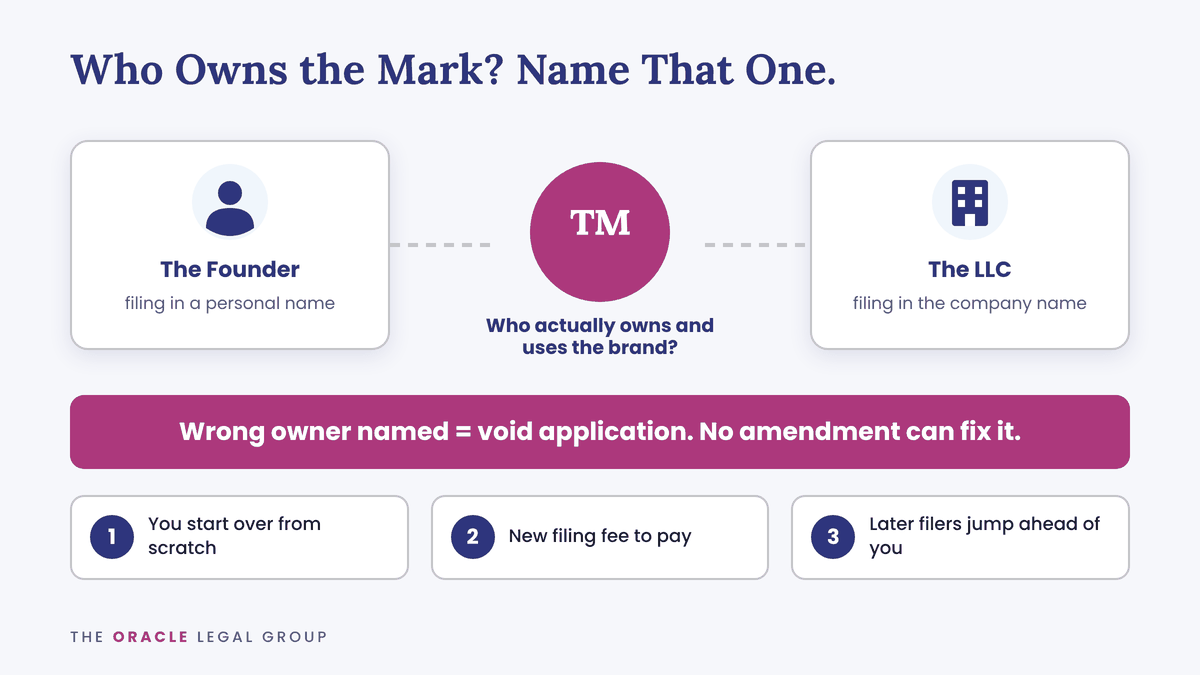
If we had to pick the single most common mistake, it would be this one, hands down. A founder forms an LLC and then files the trademark in their own personal name. Or they do the reverse: they own the brand personally but file under the company.
Why This Mistake Cannot Be Fixed
If the person or company named in the application does not actually own the mark, the application is void. The USPTO will not let you repair that with an amendment. You have to start over.
Starting over means a new filing fee and a new place in line. Anyone who filed in the meantime is now ahead of you. For a growing business, losing that place in line can be the difference between securing the name and losing it.
How to Avoid It
Before you open the application, decide who actually owns and uses the brand, and make sure that exact person or entity is the one named. If you are unsure, that is a perfect ten-minute question for an attorney, and it is far cheaper than refiling.
Two Real-World Patterns: One DIY Success and One Costly Fix
To show what the difference looks like in practice, here are two composite examples. The details are changed, but both reflect patterns we see again and again.
The Bakery Owner Who Got It Right
A small bakery owner chose a made-up name, a unique word that described nothing about baking. She was already using it to run her business, she needed protection in only one class, and she ran a careful search before she filed. She also picked her goods and services description straight from the USPTO’s pre-filled options instead of writing her own.
Her application registered without a single objection from the examiner. Honestly, if she had asked us, we would have told her to do exactly what she did.
The Software Startup That Needed Help Afterward
A software startup filed on its own for a name that basically described what the product does. Months later, the examiner came back with two problems. First, the name was merely descriptive. Second, there was already a registered mark for related goods that the examiner considered similar. The spelling was completely different, so the startup’s own search had not caught it, but the two names sounded the same when spoken aloud.
By the time the startup called us, a lot of damage had been done. They had to pay for a new trademark and absorb the cost of the marketing they had already done under the old name.
The difference between these two stories was not effort or intelligence. It was how strong the name was and how thorough the search was before filing.
Three Search Tricks Most People Miss
A good search is the best free protection a trademark applicant has. These are three habits that save time and money.
Search Broadly, Not Just the Way You Spelled It
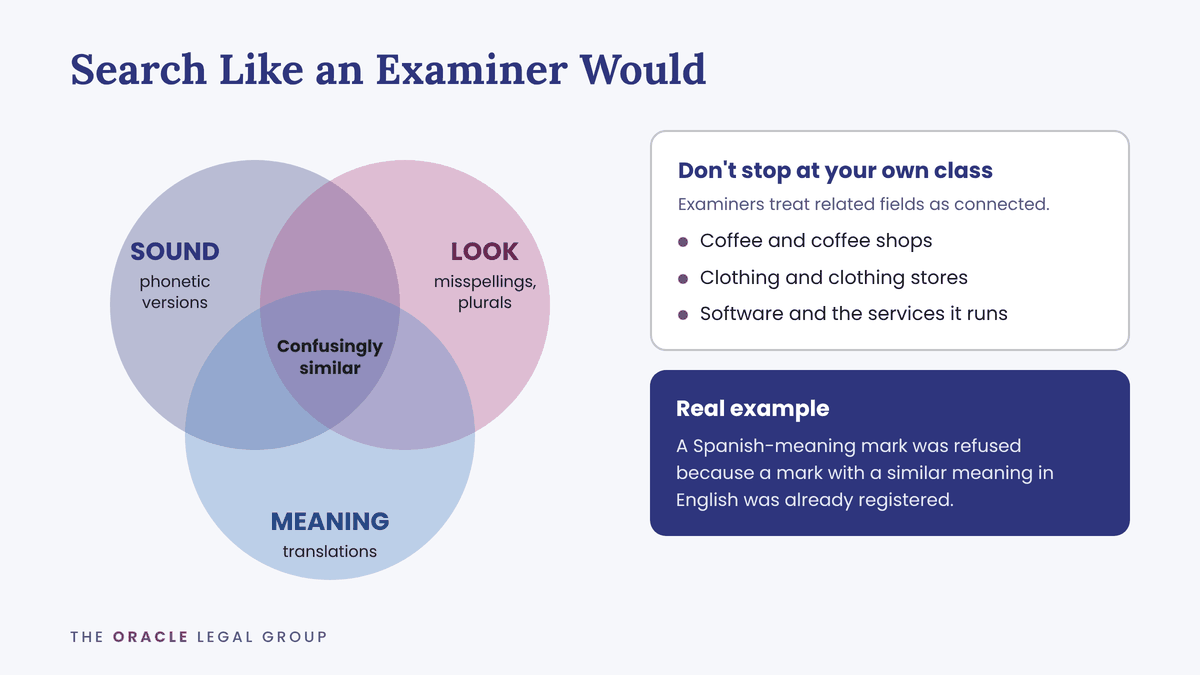
The test is whether marks are confusingly similar in sound, look and meaning. That means you should search misspellings, phonetic versions, plurals and even translations. A foreign word that means the same thing as an existing mark can be a problem.
We have seen this firsthand. A mark with a particular meaning in Spanish was rejected because a mark with a similar meaning in English had already been registered.
Do Not Stop at Your Own Class
Likelihood of confusion is not limited to the class number on your application. Examiners routinely treat marks across related fields as connected, even when they sit in different classes. Think of coffee and coffee shops, clothing and clothing stores, or software and the services that run on it.
A conflict in a neighboring field can absolutely lead to an office action or an outright rejection, so widen your search accordingly.
Do Not Write a Custom Description Unless You Need To
Whenever possible, choose your goods and services description from the USPTO’s ID Manual. The USPTO now charges at least an extra $200 per class if you write your own description. It is a small detail that quietly adds up, especially when you are filing in more than one class.
When DIY Is Safe and When You Need a Professional
The Safest DIY Profile
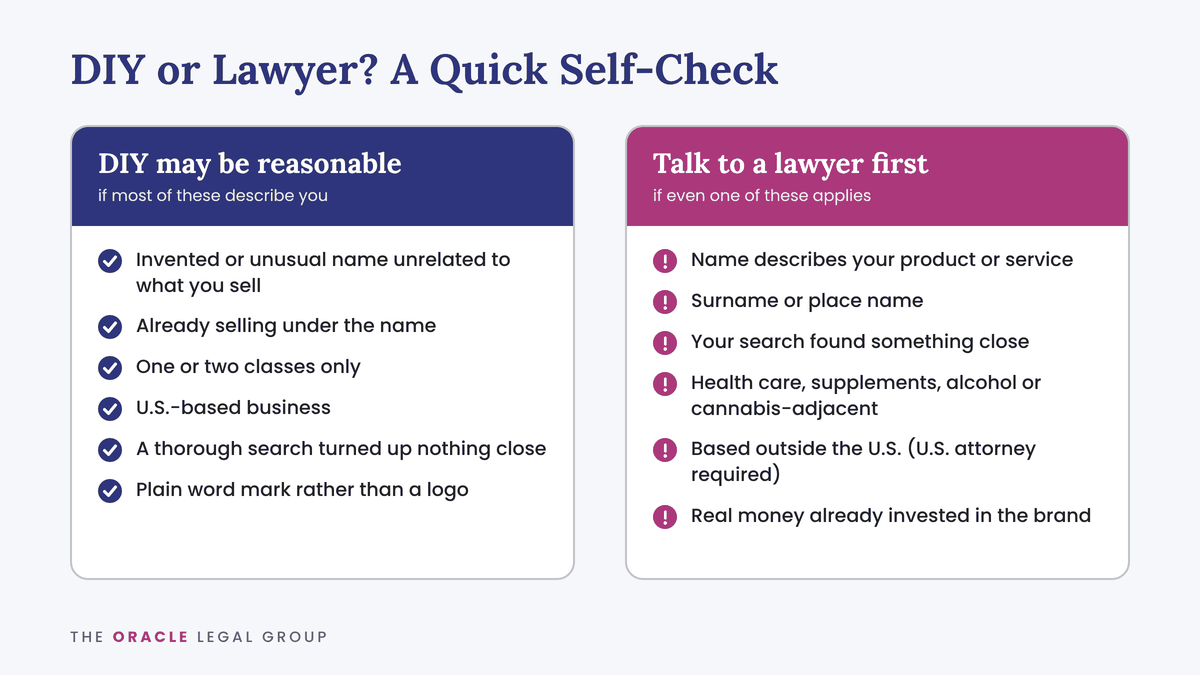
Filing on your own is most reasonable when your situation looks like this:
- You have an invented or unusual name that has nothing to do with what you sell.
- You are already using the name to sell in the marketplace.
- You only need one or two classes.
- Your business is based in the United States.
- A thorough search of the USPTO’s trademark database turned up nothing concerning.
- You are filing a plain word mark, which is simpler than a logo.
When You Are Better Off With a Lawyer
You are likely a better candidate for professional help if any of the following apply:
- Your name describes your product or service.
- Your mark is a surname or a place name.
- Your search turned up anything close.
- You operate in a regulated space such as health care, supplements, alcohol or cannabis-adjacent products, where the rules on what can register get tricky.
- You are based outside the United States. In that case, hiring a U.S.-licensed attorney is not optional, because the USPTO requires foreign-domiciled applicants to use one.
Red Flags We Spot Immediately
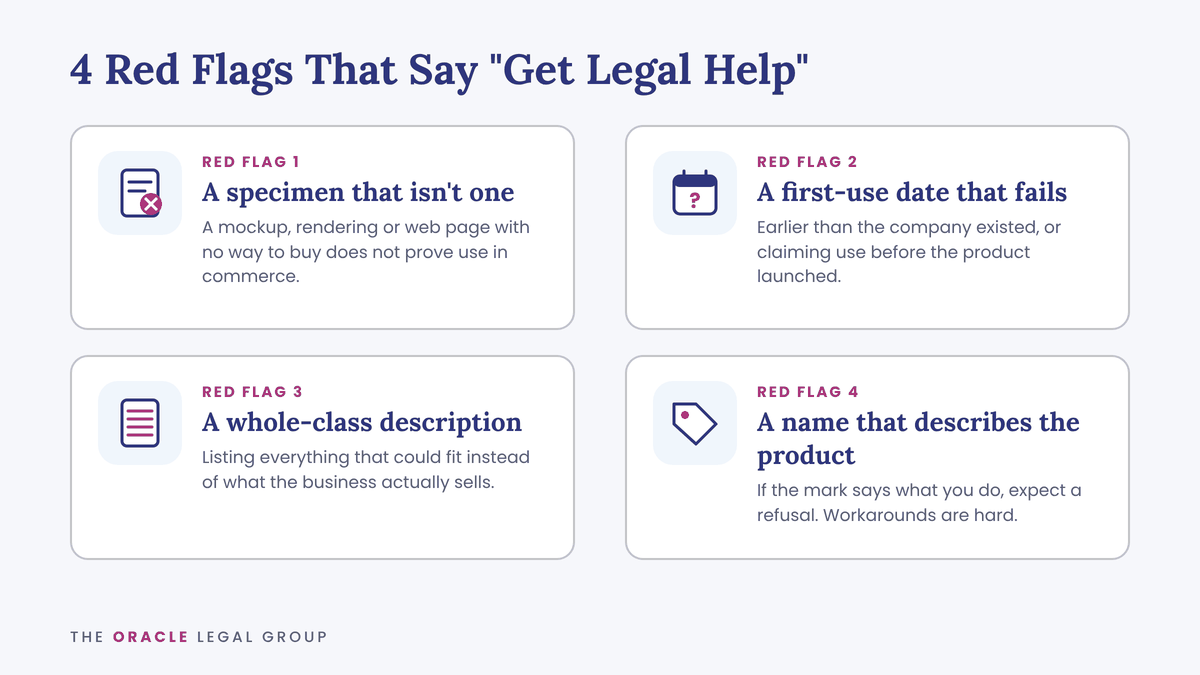
After reviewing enough applications, certain problems jump out right away. Most people would miss them, which is exactly why they cause so much trouble.
The Specimen Is Not Really a Specimen
A mockup, a rendering, or a web page with no way to buy anything does not prove you are using the mark in commerce. Examiners catch these, and a digitally altered specimen is a serious problem. If you are not yet using the mark, an intent-to-use application may be the right route. But if someone is uploading an insufficient specimen, it usually means they should have had legal help from the start.
The First-Use Date Does Not Add Up
Sometimes the claimed first-use date is earlier than the company existed, or it claims use when the product has not actually launched. That should probably have been an intent-to-use application instead, and those timelines get a hard look during examination.
The Description Claims the Whole Class
Some applicants list everything that could conceivably fall within a class instead of what the business actually sells. It feels like you are protecting yourself, but you are creating holes that can be exploited later.
The Name Describes the Product
If the mark is basically a description of what you do, expect a refusal. There are workarounds, but they are not easy and are often out of reach for a startup or early-stage company. If you want an enforceable trademark, involve counsel early and get input on how to make sure there is a path to that outcome.
What a “Cheap” DIY Filing Can Really Cost
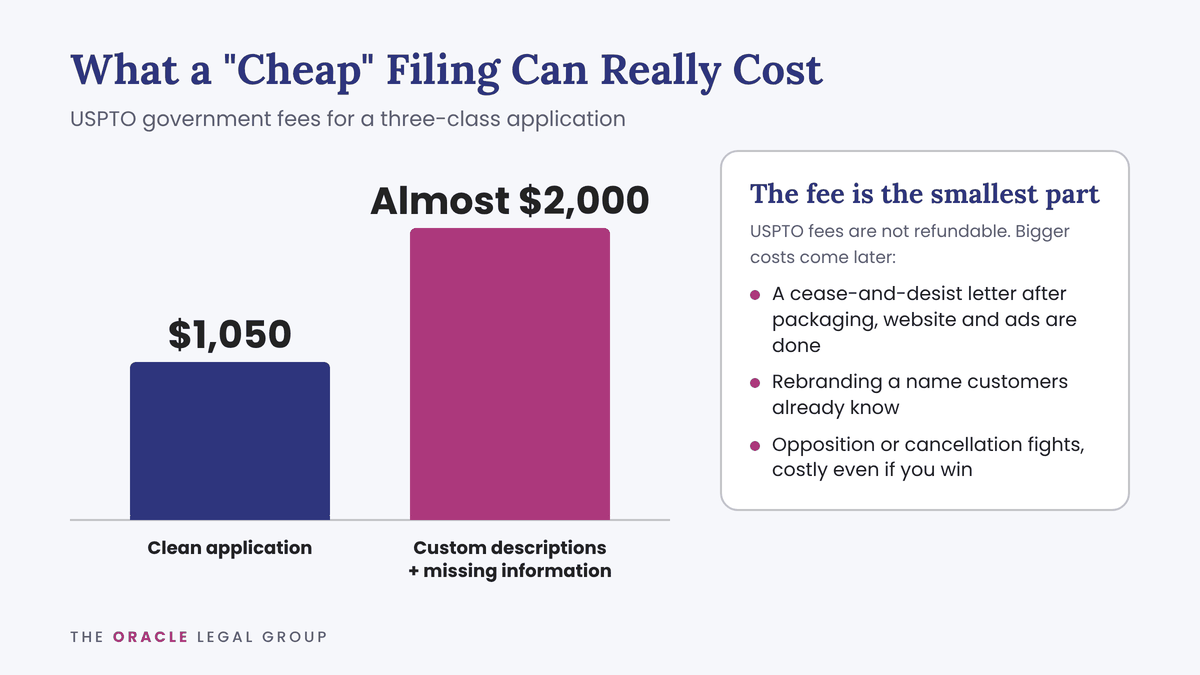
Yes, a cheap DIY filing can end up costing thousands, and the filing fee is the smallest part of it.
The Fees You Pay Twice
USPTO fees are not refundable, so an application that dies over a fixable error means paying again. Even if it is approved, a three-class application with custom descriptions and missing information can run almost $2,000 in government fees, compared with $1,050 for a clean one.
The Costs That Come Later
The government fees matter, but the real headaches and the biggest price tags come later. If you pick a name that conflicts with someone who got there first, you may receive a cease-and-desist letter after you have printed packaging, built a website, bought ads and gotten customers used to the name. Rebranding at that point is not cheap.
And if the dispute turns into a formal opposition or cancellation proceeding, the legal fees can be a disaster, even if you win.
What We Would Tell a Friend or Family Member
If a friend asked us whether to file their own trademark, we would give them the same advice every time. Do your own search first, and make it a real one, using the tricks above.
If you found something close, if the name describes what you sell, or if you have already put real money into the brand, spend an hour with a trademark lawyer before you file. In our experience, an upfront clearance conversation often costs less than responding to a single office action. It also cuts off many of the worst-case scenarios that could come up later.
Key Takeaways
- You can file a trademark yourself, but the real risk lies in the judgment calls, not the paperwork.
- Name the actual owner of the mark. A wrong owner voids the application and cannot be amended.
- Search by sound, look and meaning, across related classes, not just your own.
- Use the ID Manual for your description to avoid at least $200 per class in extra fees.
- Descriptive names, surnames, place names, regulated industries and foreign applicants should get legal help.
- One hour with a trademark lawyer before filing is usually cheaper than fixing a refusal afterward.
Talk to an Attorney Before You File
Whether you are weighing a DIY filing or already have a refusal in hand, The Oracle Legal Group can help you understand where you stand. Our team works with businesses in Houston, The Woodlands and Chicago, and we offer a free business consultation. Call us at 832-291-2798 or 346-315-4441, or visit theoraclelegalgroup.com to get started.
This article is general information, not legal advice. Your specific situation should be reviewed by a licensed attorney.